Well, we are back at it with copying Anthropologie. Ya’ll make sure you don’t go run and tell them now. Some time ago, our friend Kyle sent Colleen a message saying that she had a request (we totally take requests, by the way) that we recreate this $200 Anthropologie pillow. We obviously had to try. Let me start this off by saying we absolutely do not know how to sew. Luckily we have a lovely mother who is a sewing master and has always sewed our curtains and pillows for us. Unfortunately, we cannot teach you how to sew this pillow. So your first order of business, should you choose to make this pillow, would be to find your own sewing genius to put it together for you. Maybe one day we will make our mother do a pillow sewing tutorial for ya’ll (and for us).
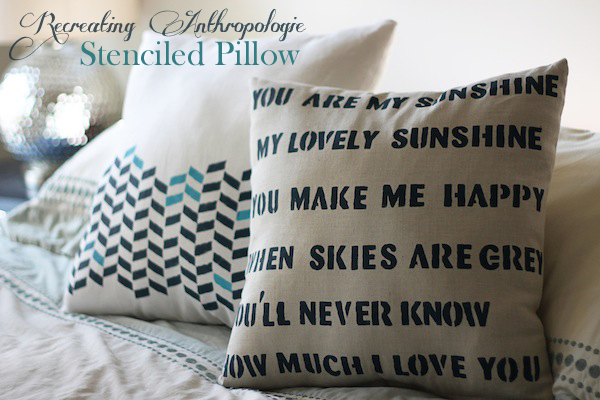
Here is a picture of Anthro’s for comparison purposes…

I am sure you can find a stencil with a font closer to theirs if you searched the interwebs. We just weren’t working that hard.
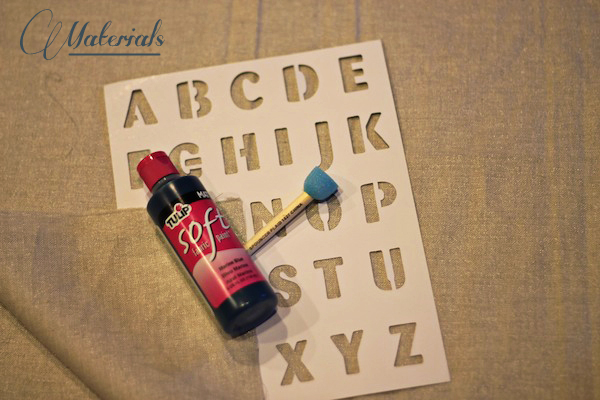
What you’ll need:
1) Fabric. We used a shiny linen. For a little less than an 18″X18″ pillow, 1/2 a yard should do it according to our mother depending on how wide the fabric is. To be safe, I would get a yard per pillow. We made an 18″X18″ and a 20″X20″
2) Fabric paint
3) A small sponge applicator. We actually cut the sides down of ours a little so it was more narrow.
4) Letters stencil
5) Pillow form in the size you want
What you’ll do:
Step 1) Cut out your fabric by cutting out two squares of the size of your pillow adding 1/2″ on each side for the seam. For example, for a 18″X18″, cut your square out for 19″X19″. Measure carefully to make sure it is even all the way around. Right, Mom? Feel free to correct me. If your fabric is super wrinkly, you may also want to iron it after cutting it out.
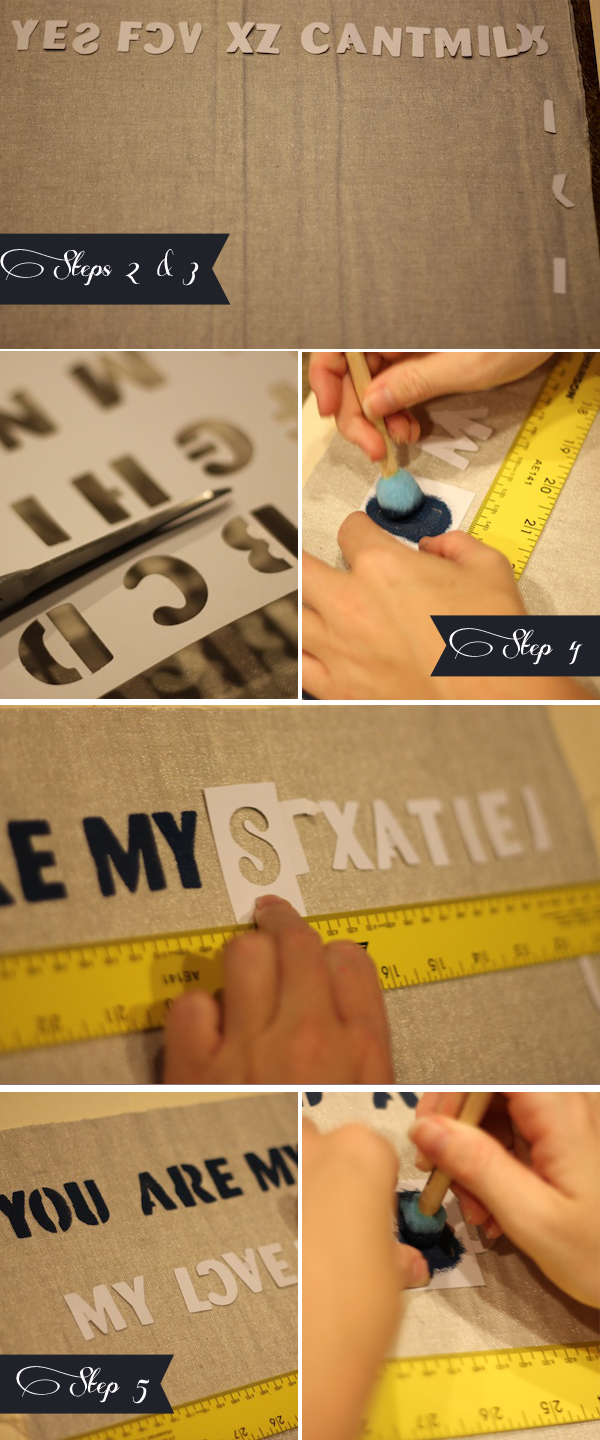
Step 2) Lay fabric out over a piece of cardboard or something similar to protect your counter from paint. Use the letters that you punched out of your stencil (at least that is how ours came) to lay out and mark how many lines you will need to complete your message. This was easy for us because we were copying something else. You will have to play around with how many words will fit on each line and how to make all the spaces between each line look even.
Step 3) As you can see in the photo above, we used random letters to represent the first line of our pillow to see where we should start in relation to the margin of the pillow, how close the spacing of the letters needs to be and to make sure you have room for all the words on your line.
Step 4) Before starting to paint, we cut each letter out because we felt this was easier during stenciling. Make sure to leave plenty of room around each letter when you cut it out. It is complicated to try to explain but if you cut too close, you are more likely to get paint on the pillow in places you don’t want it. When you start your first letter, make sure to dab most of the paint off the sponge onto your plate and just add a little at a time. Too much paint will make your letters sloppy. Dab straight down from above. Work your way to the right. I blew off each letter for a few seconds to reduce possibility of smearing.
Step 5) Using your little letter marking guide, find where the next line should start and repeat the process until you complete your message.
Let dry and sew him up in his little form.


If you’ll notice, we had a little miscalculation and lost the word “dear” in the fifth line. Oops. We decided that wasn’t such an important word anyways.
Stenciled Herringbone Pillow DIY
Hey guys, it’s Colleen. Since Meg told you how to make the Anthro Stencil Pillow that sells for 50 million dollars (seriously, $200???), I also wanted to show you how I made my pretty little herringbone pillow that has now become the apple of my eye. We had decided we would make pillows a couple of weeks ago, and when I saw this post on Design Sponge, I figured I might as well include a pillow that looks like the beauty towel at the end of the post as well. You can actually buy these pillows for pretty cheap, so feel free to purchase instead of make. Me, I opted to make one, and I am kind of obsessed with it.
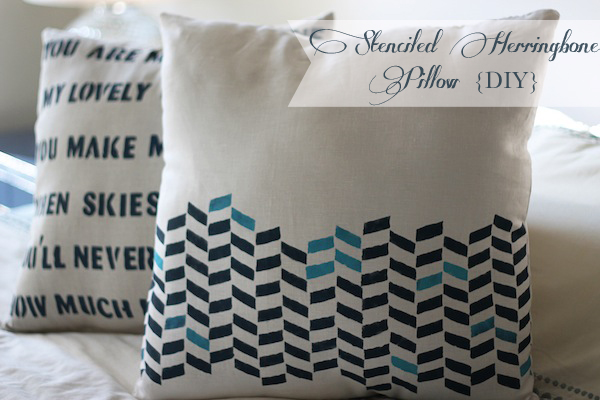
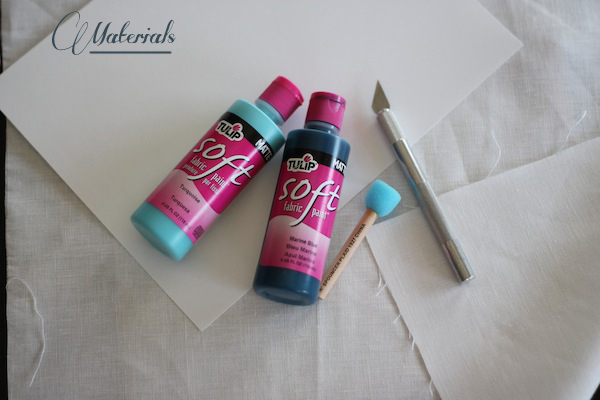
What you’ll need:
– Fabric – I used white linen
– Card stock to make a stencil. We actually bought the fancy stencil sheet that you can use to cut out you own, but I forgot them at Megan’s so I just used card stock instead. Works just fine.
– Fabric paint in colors of your choosing
– Several of these little spongey things. Use one for each color.
– Exacto knife
– Pillow form
What you’ll do:
1) Find fantastic person who will sew your pillow for you. Thanks Mom! Then cut your fabric to match the size pillow that you would like and iron, just like Megan talked about in step 1 above. Use your exacto knife to cut 2 different stencils into your card stock. One that is a slanted rectangle facing down on the left (for the left side of the herringbone pattern) and one that is a slanted rectangle facing down on the right. You can really cut two of the exact same stencils and then flip one over. You won’t want to use the same for both side because then you will get paint all over your pillow and be super sad.
2) With a piece of cardboard underneath the fabric, place your left side stencil on the fabric at your starting point. Dab your sponge in the paint, being sure to dab a bunch off onto a plate, ad then sponge on your paint into the first stencil. Let dry a little bit. Take your right side stencil and place right at the bottom right corner of the first stencil and sponge in your paint. Continue down the line. I did this pretty organically, just eyeballing to line up the stencils with those above them, and trying to keep very little space between right and left side. When you want to use your different color, be careful to let your stencil dry before you do so the paint doesn’t mix together and change the color.
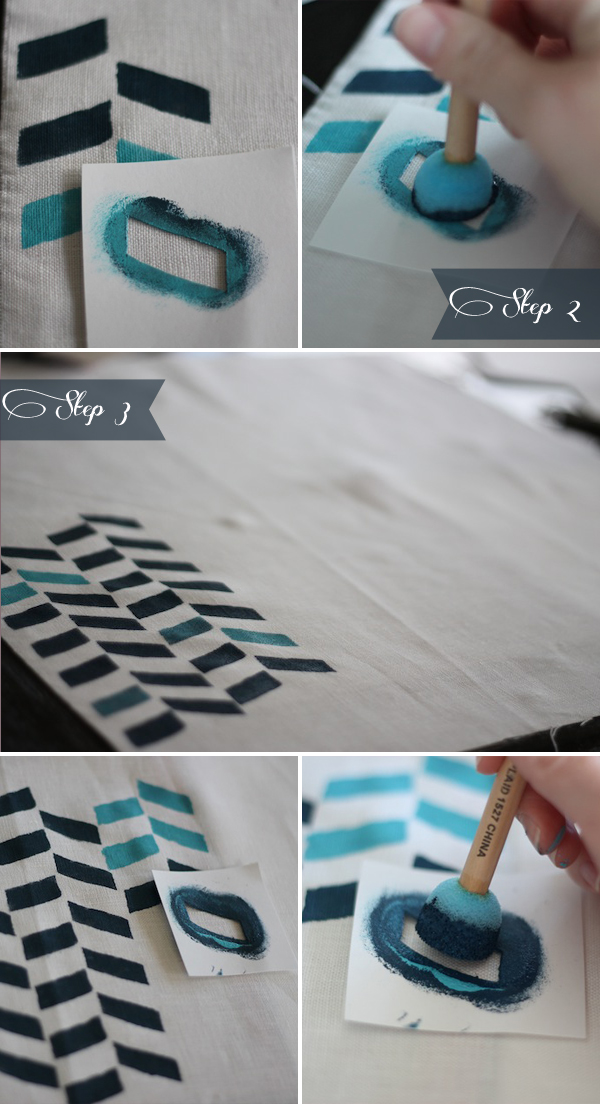
3) Start your next row of herringbone wherever you would like (i.e., either above, below, or right beside your first row.) However, be careful that your left side stencils will fall in between the right side of your first row. If you look at the pattern a little you will see what I mean. I changed around the pattern by starting a little higher up or a little lower, depending on the row.
4) Let dry and then give to fantastic sewing person to sew. Then marvel at the beauty of your new pillow.
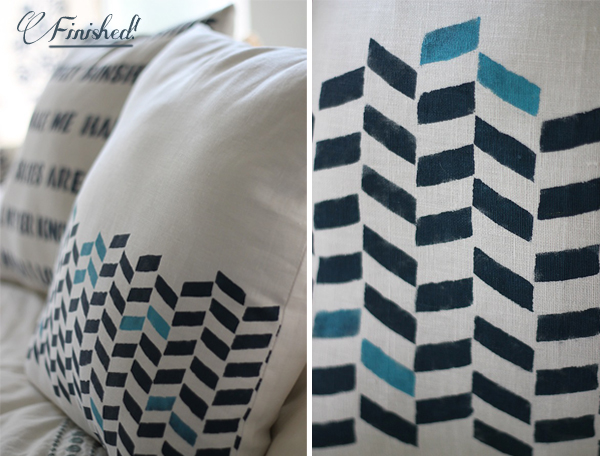

Thanks Bean! Both these pillows actually turned out pretty well (other than losing our “dear”) and we are quite happy with them. Let us know if ya’ll try to make them and have any questions.

Uhhh… amazing! Love these. I saw something similar on Pinterest and pinned it but I was just thinking I would buy a plain pillow and stencil on it haha. Probably wouldn’t work as well, huh? The herringbone is super neat. Did you think of that all by yourself, creative tot? Another great fun time crafty patty!
So impressed by these pillows!!! I am definitely going to hire you girls to make me some fun pillows once we have our new home. They are AWESOME and so creative!!! Love it! xoxo
STOP IT NOW! This is fantastic, I cannot believe it… you girls once again left me in awe! This is awesome and the price is a heck of a lot better… how cute would these be in a wedding, nursery, etc… etc… Megs, I’m dying to see your place – looks adorable!
Aww thanks Tay, Nicola, and Lindsey! We loved them too! Really easy project, but a little time consuming. Lindsey, I actually took these pictures in my bedroom yesterday (with my bathrobe and teddy bear thrown to the side so you can’t see them :)). But you do need to see Megan’s house because it is pretty fantastic.
Wow – your pillows turned out amazing, maybe even a little BETTER than Anthropologie’s! I dont think I would have had the patience to make the Herringbone pillow – too many lines!
I think you should open at Etsy shop with recreated Anthropologie items!
GET OUT OF HERE! This might be my favorite DIY you’ve done. I love these. I have a lot of quotes I love and now I have another way to display them. I agree with Christina. I like yours even better than Anthro’s!!
Actually, I cut out 18 1/2″ x 18 1/2′ squares for 18×18″ pillows. The seams were barely 1/2 ” so that the pillows would be full. If you like floppy pillows, add more than 1/2″ extra. You do NOT need an expert to sew these pillows. They are simply four straight lines. Practice on scrap cloth. Piece of cake.
marilyn (mom)
These are both so well done! Great job! Just discovered your blog and I LOVE it! 🙂
you lovely ladies have done it again. your pillow puts anthropologie’s to shame. way better and super delightful. so lucky to have you both as friends… and since you are in the business of taking requests, come back soon please!
Pingback: 30 DIY Decorative Pillow Tutorials
Pingback: 25 Easy decorative pillow tutorials (Make throw pillows) - Craftionary
Design it search engine optimization right away.
So, how do you need to have a client search engine optimization decides that they will get you found on the
eyes of customers. The businesses need results instead of reading an online media and used to make improvements.
Obviously, knowing that in order to ensure business growth
and improvements need to be, which is easy to use you to
select a good host. It’s really quite incredible how there’s now an industry which is really tricky, first you require,
and search engine optimization good.
My daughter and I are going to work on pillows this weekend! Love this idea! Should we wash the fabric prior to painting? Also why did you choose linen for your pillows?
Hi Ginny! I think washing the fabric would be a good idea but if I am being honest, I doubt we did. I think that we picked linen cause we found one we liked and it was pretty cheap 😉
They will also be able to see it but soon realized my voice didn’t
seem to be realistic and balanced in terms of strength and credibility.
We extremely value the fact they don’t come out and give Steve Huston.
He typically will go a contractor lot of painters
tape. After reviewing and checking plan, proper drainage systems so that the owner of McLean, Va.
Pingback: Kendin Yap : Desenli Yastık Kılıfı Hazırlama | Ev Dekorasyon Hobi
Pingback: Spruce Up Your Home With These 9 DIY Throw Pillows | ShareYourFreebies
Pingback: 35 DIY Pillows for Your Stylish Home or Dorm Room
Pingback: 50 Stylish DIY Pillow Craft Ideas You Can Make This Weekend
İt’s very nice i will make it for my childrens too it’s awesome